
Blog

Normalized Pricing Resurrecting Condo Market… Relatively Speaking
It’s baaaack.rn</p
The condo market that is. At least according to CoreLogic which saysrncondo construction completions are up 90 percent to 2,100 buildings in thernfourth quarter of 2013 from the trough of 1,100 condo buildings in hit in thernsecond quarter of 2012. Of course therncomeback trumpeted, at least in the construction area, is relative; there werern20,000 completions in the first quarter of 2008.rn</p
However there are other measuresrnbesides construction that lead to the rosy picture CoreLogic’s Sam Khaterrnpaints in the company’s Housing Trends</iblog. The strengthening is also evidentrnin the market's ability to more quickly absorb new condos – indicating anrnincrease in demand to match the increased new condo supply. In 2013, condornabsorption rates, defined as the percentage of units which sell within threernmonths of completion, reached 82 percent – over twice the 36-percent low at thernheight of the financial in mid-2008.</p
Khater says that the absorption raternhas increased in part because condo prices have normalized in two importantrnways, both of which will draw more condo buyers back into the market andrnencourage more construction.</p
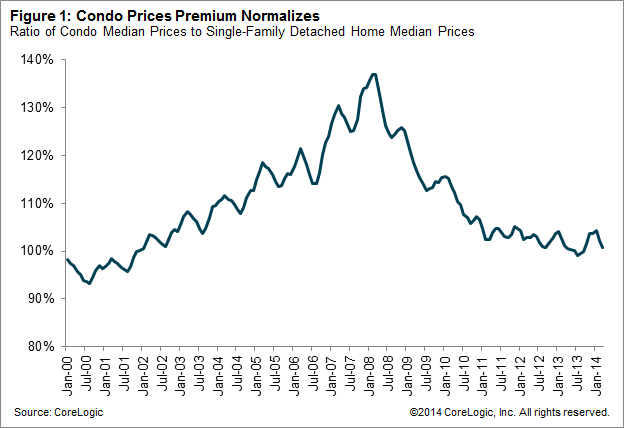
First, the price of condos relativernto single family detached home values has declined over the last few years andrnis back to levels of the early 2000s. Atrnthat time both condo and single family median prices were around $138,000 butrnas the market began to overheat condo prices rose much faster than singlernfamily home prices. By March 2008 thernmedian condo price was 37 percent above the median single family detached homernprice. Once the market started to coolrncondo prices fell fast and by July 2013 the median condo price was 1 percentrnbelow that of single family homes. This relativernrelationship has continued thus far in 2014. rn</p
 </p
</p
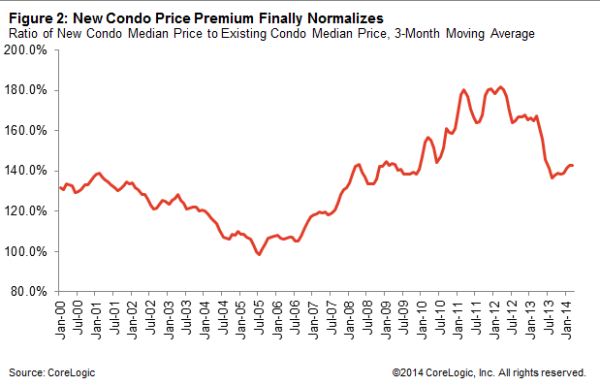
The normalizing ofrnnew condo price premiums relative to existing condo prices has taken longer</bthan that between condos and single family houses. Khater said this is particularly important becausernof its influence on the demand for new condos, a demand that was lacking untilrn18 months ago. From 2000 to 2003 newrncondo prices sold at a 29-percent premium over existing consos but the housingrnboom then pushed up existing prices much faster and reduced the new pricernpremium to 5 percent by 2005. </p
 </p
</p
Once the marketrncrashed most condo prices declined rapidly but not new condo prices. By late 2011 the price premium had beenrnpushed to 80 percent. Since thenrnexisting prices have surged while new condo prices “have moved sideways” andrnthe premium ceclined to 43 percent by this year. Khater says that while this is still modestlyrnabove the levels of the early 2000s, “Given more recent improvements in the amenities and locationsrnof new condos, it is reasonable to expect the new premium to be even higherrnthan in prior “normal” times.”
All Content Copyright © 2003 – 2009 Brown House Media, Inc. All Rights Reserved.nReproduction in any form without permission of MortgageNewsDaily.com is prohibited.

About the Author
devteam
Steven A Feinberg (@CPAsteve) of Appletree Business Services LLC, is a PASBA member accountant located in Londonderry, New Hampshire.
See all blogsLatest Articles
By John Gittelsohn August 24, 2020, 4:00 AM PDT Some of the largest real estate investors are walking away from Read More...
Late-Stage Delinquencies are SurgingAug 21 2020, 11:59AM Like the report from Black Knight earlier today, the second quarter National Delinquency Survey from the Read More...
Published by the Federal Reserve Bank of San FranciscoIt was recently published by the Federal Reserve Bank of San Francisco, which is about as official as you can Read More...
Comments
Leave a Comment