
Blog

The High Cost of Failing to Refinance
CoreLogicrnrecently awarded its Academic Research Council Excellence Award to a studyrnconducted by professors from three universities who looked at reasons why sornmany homeowners fail to refinance their homes even when it is financiallyrnadvantageous to do so. The award forrnscholarly research in the real estate and mortgage fields was given to Benjamin J.rnKeys, Harris School of Public Policy, University of Chicago; Devin G. Pope,rnBooth School of Business, University of Chicago; and Jaren C. Pope, Departmentrnof Economics, Brigham Young University and their paper “Failure to Refinance.”</p
According to the study, housingrndecisions can have substantial long-term consequences for household wealthrnaccumulation because almost two thirds of the median household’s total wealthrnis from housing. Public policies havernbeen crafted to encourage homeownership but their effectiveness hinges onrnhomeowners’ wise housing decisions.</p
One decision is the choice to refinancerna home mortgage. Failure to do so canrncost a household tens of thousands of dollars in savings. When mortgage rates reached all-time lows inrnthe vicinity of 3.35 percent in late 2012 a household with a $200,000 mortgagernand an interest rate of 6.5 percent would save roughly $130,000 over the lifernof the loan by refinancing.</p
Yet many did not, and while thisrnappears puzzling the authors say it is consistent with recent work inrnbehavioral economics. Homeowners may have many reasons for failing to refinance;rnbad credit or a lack of equity or a change of moving in the near future. Often the benefits of refinancing are notrnimmediate but accrue over time and there can be a number of costs, bothrnfinancial and non-financial that households must pay in order to completernrefinancing. Further many households have limited experiencernwith calculating the financial benefits they might receive. </p
The authors attempt to provide empiricalrnevidence about how many households appear to be suffering from a failure tornrefinance and the magnitude of their mistakes by analyzing a nationallyrnrepresentative sample of 1.5 million single family mortgages from the CoreLogicrndatabase that were active in December 2010. rnThey merged this with 2010 zip-code level census information on medianrnincome, education levels and other variables. rnGiven the information available the authors could calculate how manyrnhouseholds would save money over the life of the loan were they to refinance atrnthe prevailing interest rate. The datarnalso allowed them to reasonably separate out homeowners who could not refinancernfrom those who sub-optimally fail to do so. </p
They concluded, based on what theyrncalled conservative assumptions, that about 20 percent of households inrnDecember 2010 had not refinanced when it appeared profitable to do so. They also calculated that the medianrnhousehold holding on to that too-high rate mortgage would have savedrnapproximately $45,000 over the life of the loan by refinancing or approximatelyrn$11,500 when adjusting for discounting for time and tax incentives. </p
By December 2012, when interest ratesrnreached historic lows approximately 40 percent of those non-refinanced 2010rnhouseholds were still in their homes and still had not refinanced. Thesernresults suggest that the size and scope of the problemrnof failing to refinance is large. </p
A typical active loan in Decemberrnof 2010 was paying 5.52% interest, had 23 years remaining and an unpaidrnbalance of just over $200,000.rnThe average loan-to-value ratio at origination was approximately 70% and in 2010 was 74%. While the average interestrnrate being paid is 5.52%,rnthere is substantial variation with many households paying interest rates near the market rate in Decemberrn2010 (~4.3%) and other households paying interest rates well over 6%. The distribution of rates was narrower in thernsample restricted to those households that appeared able to refinance. </p
Assuming thatrnall households could refinance in December 2010 at the prevailing rate of 4.3rnpercent the authors estimated the savings after adjusting by upfront costs andrnestimated that 91.4 percent could save money over the life of the loan byrnrefinancing. Taking into considerationrnthe mortgage interest rate tax deduction, the probability of moving andrndiscounting of money over time that was reduced to 41.2% of households in thernfull sample. They also put the present discounted value ofrnrefinancing after all considerations at $13,000.</p
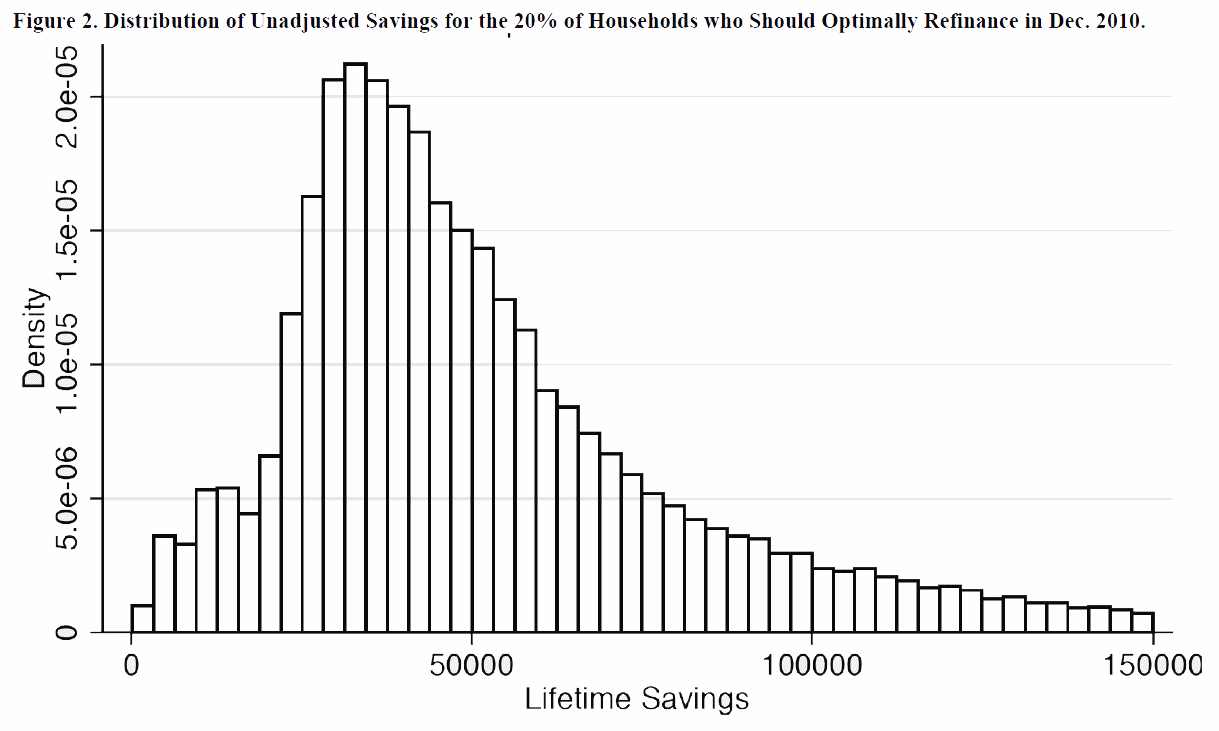
The 41.2 percent was furtherrnreduced to 31.1 percent by screening out households with low credit scoresrnand/or high loan to value ratios at their loan’s origination. Further reductions were made by estimatingrndamaged credit or diminished equity after origination. The final estimate is that 20% of households in Decemberrnof 2010 were subrnoptimally in a state of not refinancing. rnThe unadjusted savings available to this 20 percent of householdsrnaveraged $45,473 although there was a great deal of variation in thatrnnumber. The present-discounted value ofrnforgone savings was approximately $11,500.</p
 </p
</p
If interest rates had increased sharply starting in Decemberrn2010 the authors estimate that approximately 20% of households would have lost theirrnchance to refinance even though it would have been optimal for them to do so. Interestrnrates, however, continued to decline throughrnthe end of 2012, providing an opportunity for the 20% of households that failed to refinance inrnDecember 2010 to do so and realize even greater savings from the lower rates. Howeverrnthey found that 40 percent of households that should have refinanced in 2010 were still livingrnin their house by December 2012, continued to make full and on-time monthly payments, yet had not refinanced despite the furtherrndecline in interest rates.</p
The available data does notrnallow the authors to provide detailed information about these households thatrnfail to refinance despite the large financial stakes however it was possible tornmake some broad assumptions. First, the failure to refinance is morernprevalent among households that have worse credit,rnand slightly more prevalent in neighborhoods with lower education and income levels but the differences were small. </p
In an attempt to get more detailedrninformation the authors partnered with a non-profit company called Neighborhood Housing Servicesrnof Chicago (NHS)rnwhich provides housing related services primarily to lower-income communitiesrnincluding homeowner education and foreclosure prevention. NHS is also a mortgage lender and servicerrnand actively encourages clientsrnto refinance when interestrnrates decrease.</p
In July of 2011, NHS sent a letter to 446 client households with an offer to refinance their currentrnmortgage loan at a 4.7% interest rate with no up-front money required. Thernletters went only to households pre-determined to be eligible and who wouldrnbenefit from refinancing. Eighty-fourrnpercent of recipients did not respond to the offer; the 16 percent who did would go on to pay $24,500rnless in total interest paymentsrnover the life of the loan while the 84 percent that did not respond sawrnforgone savings of $17,700.</p
NHS sentrnout a second letter in July 2012 offering 140 of primarily the same clientrnhouseholds the opportunity to refinance at 3.99 percent and 75 percent did notrnrespond, forgoing unadjusted savings of $24,700 while the 24.3 percent who didrnrespond had savings of $29,900.</p
After a third salvo of 193 lettersrnwas sent in May of 2013rnwith only a 13 percent response rate the authors worked with NHS to conduct arnsurvey by phone of non-refinancing households. rnWhile the responses were thin, up to ¼ of households said they did notrnopen the letter. Of those that did 1/3rnsaid they intended to pursue the issue but didn’t get around to it. Another third did not find the savings significantrnenough to warrant a call and about a third said they would be willing to have arnloan officer call them to discuss a loan.</p
Thernauthors also cite the parallel with their research of the current governmentrneffort to encourage refinancing. In 2009rnthe Treasury Department introduced the Home Affordable Refinance Program (HARP)rndesigned to help current borrowers under federally guaranteed programsrnrefinance even with high loan-to-value ratios and estimated that 4 to 5 millionrnborrowers could take advantage of it. By September 2011, however, less than a million borrowersrnhad actually done so – remarkably similar to the results ofrnthis analysis. Modifications to the programrnhave encouraged greater participationrnbut the total take up rate remains low.</p
The writers say the magnitude of the financialrnmistakes that households make suggestrnthat psychological factorsrnsuch as procrastination and the inabilityrnto understand complex decisions are likely barriers to refinancing. One policyrnthat has been suggestedrnto overcome the need for active household participation would require mortgagesrnto have fixed interestrnrates that adjustrndownward automatically when rates decline.rnTo the extent that it is undesirable to reward only those households that are able to overcomernthe computational and behavioral barriersrnof the refinance process, policiesrnsuch as an automatically-refinancing mortgagernmay be beneficial.
All Content Copyright © 2003 – 2009 Brown House Media, Inc. All Rights Reserved.nReproduction in any form without permission of MortgageNewsDaily.com is prohibited.

About the Author
devteam
Steven A Feinberg (@CPAsteve) of Appletree Business Services LLC, is a PASBA member accountant located in Londonderry, New Hampshire.
See all blogsLatest Articles
By John Gittelsohn August 24, 2020, 4:00 AM PDT Some of the largest real estate investors are walking away from Read More...
Late-Stage Delinquencies are SurgingAug 21 2020, 11:59AM Like the report from Black Knight earlier today, the second quarter National Delinquency Survey from the Read More...
Published by the Federal Reserve Bank of San FranciscoIt was recently published by the Federal Reserve Bank of San Francisco, which is about as official as you can Read More...
Comments
Leave a Comment